
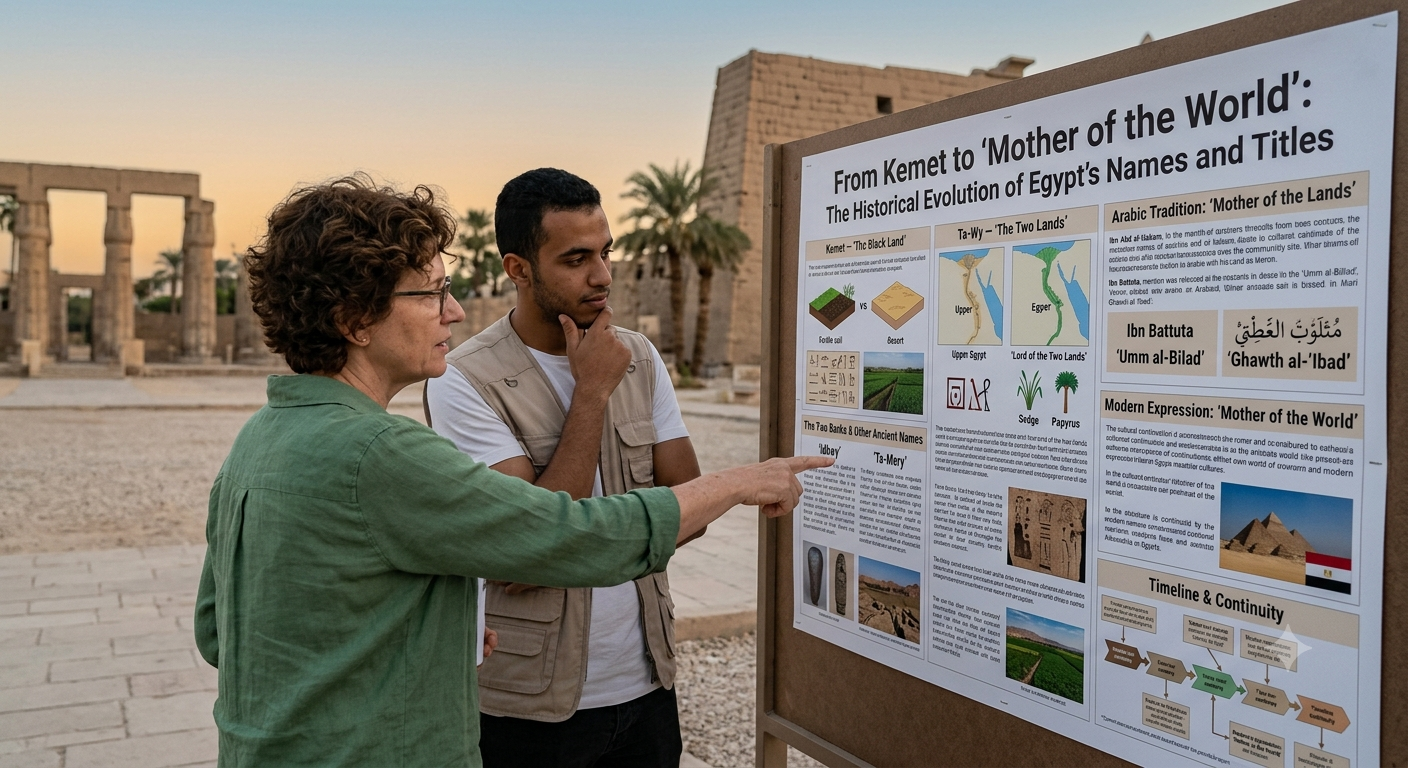

From Kemet to “Mother of the World
The Historical Evolution of Egypt’s Names and Titles
Egypt is one of the oldest civilizations in human history, and its identity has been expressed through many names and descriptions over thousands of years. These names were not merely geographical labels; they reflected how Egyptians understood their land, its relationship with the Nile, its fertility, its political unity, and its importance to surrounding peoples.
From the ancient Egyptian Kemet, through the Arabic-Islamic description “Mother of Lands and Provider for the People,” to the modern expression “Egypt, Mother of the World,” we can trace a long cultural history of how Egypt came to be regarded as a land of exceptional importance.
It is important, however, to distinguish between expressions that are actually documented in ancient Egyptian texts and later descriptions that emerged in Arabic and Islamic literature.
1. Kemet — “The Black Land”
One of the best-known ancient Egyptian names for Egypt is:
Kmt — Kemet
Traditionally, it is translated as:
“The Black LandThe Black Land.”
The term referred to the fertile agricultural land of the Nile Valley, whose dark soil contrasted with the surrounding desert, known as Deshret, or “the Red Land.”
This distinction was fundamental to the Egyptian conception of their environment.
The Nile was therefore not simply a river. Its annual inundation created the fertile soil upon which Egyptian agriculture and civilization depended.
The contrast between Kemet, the fertile land, and Deshret, the desert, represents one of the earliest documented conceptual divisions between the inhabited, cultivated world and the surrounding wilderness.
The Library of Alexandria’s Ancient Egyptian Hieroglyphs Learning Project lists Kmt among the ancient names of Egypt.
Source: Bibliotheca Alexandrina, Learn Hieroglyphs – Names of Ancient Egypt
2. Ta-Wy — “The Two Lands“The Two Lands”
Another fundamental Egyptian expression was:
Tꜣwy — The Two Lands
This referred to:
- Upper Egypt
- Lower Egypt
The concept of the “Two Lands” was central to Egyptian political ideology. Although Egypt consisted geographically of different regions, the ideal Egyptian state was a unified kingdom.
This idea appears repeatedly in royal titles.
The king could be described as:
nb Tꜣwy
meaning:
“Lord of the Two Lands.”
This was not simply a ceremonial title. It expressed the fundamental political concept of a unified Egypt.
Source: Bibliotheca Alexandrina, Ancient Egyptian Hieroglyphs Learning Project
3. The Two Banks — Egypt and the Nile
Ancient Egyptian terminology also included:
Idbwy
generally understood as:
“The Two Banks.”
The expression reflects another fundamental aspect of Egyptian geography: the Nile.
Egyptian civilization developed along the river and its agricultural valley. Consequently, descriptions of Egypt were frequently connected to the river, its banks, its agricultural land, and the distinction between cultivated territory and desert.
Source: Bibliotheca Alexandrina – Names of Ancient Egypt
4. The Land of the South and the Land of the North
Egyptian texts also distinguished between:
Tꜣ-šmꜥw
The Land of the South
associated with Upper Egypt,
and:
Tꜣ-mḥw
The Land of the North
associated with Lower Egypt.
Together, these concepts contributed to the larger Egyptian idea of Tꜣwy — the Two Lands.
Thus, ancient Egyptian terminology could describe Egypt simultaneously as a fertile land, a unified kingdom, two geographical regions, and the land surrounding the Nile.
5. Ta-Mery — A Beloved Land
Another ancient Egyptian name associated with Egypt is:
Tꜣ-mry — Ta-Mery
It is commonly interpreted in Egyptological literature in connection with the idea of the “beloved land”, although the precise linguistic interpretation requires attention to the context in which the term appears.
The expression is particularly interesting because it demonstrates that ancient Egyptians did not view their country merely as territory. Egypt could also be described through concepts of attachment, fertility, and belonging.
This is important when considering the much later cultural expression “Mother of the World.”
The two expressions are not linguistically equivalent, but both belong to a broader tradition of giving Egypt a special and elevated status.
6. Egypt and the Idea of Life
The ancient Egyptian conception of Egypt was inseparable from the Nile.
The cultivated valley was the place where crops grew, communities lived, and the state flourished.
The desert surrounding the valley was fundamentally different.
Consequently, the Egyptian worldview created a powerful symbolic association:
Nile → Fertility → Agriculture → Food → Life → Civilization
This helps explain why later generations continued to describe Egypt as a land that provided sustenance and prosperity.
The famous Egyptian civilization was therefore not only built beside the Nile; its entire economic and religious worldview was deeply connected to it.
7. From Ancient Egypt to the Arabic Tradition
Centuries after the Pharaonic period, Egypt acquired new descriptions in Arabic literature.
One of the most significant expressions is:
“Umm al-Bilad wa-Ghawth al-‘Ibad”
usually translated as:
“Mother of the Lands and Provider/Relief of the People.”
This expression is particularly important because it is sometimes incorrectly presented as an ancient Egyptian title.
It is not an attested Pharaonic expression.
Rather, it appears in the later Arabic-Islamic literary tradition.
8. Ibn Abd al-Hakam and “Mother of the Lands”
The historian Ibn Abd al-Hakam (d. 257 AH / 871 CE) recorded a tradition concerning Egypt in his work:
Futuh Misr wa-al-Maghrib
In a report attributed to Ibn Abbas, Egypt is described as:
“Umm al-Bilad wa-Ghawth al-‘Ibad”
— “Mother of the Lands and Provider for the People.”
The same tradition describes Egypt as a blessed land and praises its river.
This text is important because it provides an early documented example of the idea of Egypt as a country whose fertility and resources benefit others.
Source: Ibn Abd al-Hakam, Futuh Misr wa-al-Maghrib, p. 27 in editions cited by Egyptian scholarly/religious references.
See also: Egyptian Dar al-Ifta – discussion of the tradition
9. “Ghawth al-‘Ibad” — Provider for the People
The expression:
Ghawth al-‘Ibad
can be understood as referring to a source of assistance, relief, sustenance, or benefit for people.
This description fits the traditional perception of Egypt as a highly fertile land whose agricultural production depended upon the Nile.
In later Arabic literature, Egypt was repeatedly praised for its fertility, abundance, strategic position, and wealth.
Thus, the expression “Mother of the Lands and Provider for the People” carries a powerful image:
Egypt is a land from which other people can receive sustenance and benefit.
10. The Persistence of “Mother of the Lands”
The expression did not disappear after Ibn Abd al-Hakam.
Descriptions of Egypt as Umm al-Bilad — “Mother of the Lands” continued to appear in Arabic historical and geographical literature.
Among the authors associated with descriptions and traditions concerning the special status of Egypt are:
- Al-Kindi
- Al-Bakri
- Al-Maqrizi
- Al-Nuwayri
- Al-Suyuti
- Ibn Taghribirdi
- Ibn Battuta
These works belong to different periods and should not be treated as evidence that all the traditions they repeat originated in ancient Egypt. Rather, they demonstrate the continuation of a powerful literary tradition concerning Egypt’s exceptional status.
Source: Egyptian Dar al-Ifta – Egypt as “Mother of the Lands”
11. Ibn Battuta and “Mother of the Lands”
The famous Moroccan traveler Ibn Battuta visited Egypt in the eighth century AH / fourteenth century CE.
In his famous travel account, Rihla, he referred to Egypt as:
“Mother of the Lands.”
This is particularly interesting because Ibn Battuta was not an ancient Egyptian historian. He was a medieval traveler describing Egypt from the perspective of the Islamic world.
His description demonstrates that the idea of Egypt as a central and exceptional land was firmly established in medieval Arabic geographical literature.
Source: Ibn Battuta, Rihla (The Travels of Ibn Battuta), commonly cited in editions at approximately vol. 1, p. 201.
12. Egypt as a Land of Abundance
Later Arabic lexicographical literature also preserved similar descriptions.
The great Arabic lexicographer Al-Zabidi, in Taj al-‘Arus, records descriptions of Egypt that include expressions such as:
“Mother of the Lands”
and
“Provider for the People.”
Egypt was also described in the tradition as a land of exceptional fertility and abundance.
Source: Al-Zabidi, Taj al-‘Arus, entries relating to Egypt; see also the Egyptian Dar al-Ifta’s discussion of these traditions.
13. So Where Did “Mother of the World” Come From?
This is the crucial distinction.
There is no known ancient Egyptian hieroglyphic text that literally calls Egypt “Mother of the World.”
Nor is Kemet a translation of “Mother of the World.”
Instead, we can trace a broader historical development:
Ancient Egyptian period
Kemet
The Black Land — the fertile land of the Nile
Tꜣwy
The Two Lands — Upper and Lower Egypt
Idbwy
The Two Banks
Other expressions described Egypt through its geography, fertility, political unity, and relationship with the Nile.
⬇️
Medieval Arabic-Islamic tradition
Umm al-Bilad
Mother of the Lands
Ghawth al-‘Ibad
Provider/Relief of the People
⬇️
Modern popular expression
Egypt — Mother of the World
The modern expression can therefore be understood as a cultural continuation and expansion of the older idea of Egypt as “Mother of the Lands,” rather than as a direct translation of an ancient Egyptian name.
14. The Deeper Historical Connection
Although the words changed, there is a remarkable continuity in the image of Egypt.
Ancient Egyptian civilization understood its homeland through:
Land + Nile + Fertility + Unity + Life
Medieval Arabic writers described Egypt through:
Fertility + Abundance + Benefit + Centrality + Sustenance
Modern Egyptians and visitors commonly summarize this exceptional historical position through:
“Egypt, Mother of the World.”
Therefore, the expression is not literally Pharaonic, but its underlying cultural idea has very deep roots.
Egypt has repeatedly been imagined as a land that gives rather than merely receives.
15. The Most Historically Accurate Conclusion
The most accurate historical statement is not:
❌ “The Pharaohs called Egypt Mother of the World.”
There is no reliable ancient Egyptian textual evidence for that exact statement.
Instead, the evidence supports the following:
Ancient Egyptians had several names for their country, including Kemet (“the Black Land”) and Tꜣwy (“the Two Lands”), reflecting its fertile soil, the Nile, and the political unity of Upper and Lower Egypt.
Later, Arabic and Islamic writers developed a separate literary tradition in which Egypt was described as:
“Umm al-Bilad wa-Ghawth al-‘Ibad” — “Mother of the Lands and Provider for the People.”
This description continued through medieval historical and geographical literature, including the writings of Ibn Battuta and others.
Over time, the popular expression:
“Egypt, Mother of the World”
became a powerful modern description of Egypt’s extraordinary historical and civilizational importance.
Thus, “Mother of the World” is not a literal Pharaonic title, but it can reasonably be understood as the modern expression of a much older tradition that regarded Egypt as a uniquely fertile, central, influential, and life-giving land.
Selected Academic and Historical Sources
- Ibn Abd al-Hakam, Futuh Misr wa-al-Maghrib — early Arabic historical source containing the “Mother of the Lands and Provider for the People” tradition.
- Al-Maqrizi, Al-Mawa’iz wa-al-I’tibar fi Dhikr al-Khitat wa-al-Athar (Khitat) — one of the most important medieval works on the history and geography of Egypt.
- Ibn Battuta, Rihla (The Travels of Ibn Battuta) — medieval firsthand account of Egypt.
- Al-Suyuti, Husn al-Muhadara fi Akhbar Misr wa-al-Qahira — major medieval/early modern compilation on Egyptian history.
- Al-Zabidi, Taj al-‘Arus — major Arabic lexicographical source containing traditional descriptions and names associated with Egypt.
- Bibliotheca Alexandrina, Ancient Egyptian Hieroglyphs Learning Project — educational material on ancient Egyptian names, terminology, and royal titles.
Bibliotheca Alexandrina – Learn Hieroglyphs - University College London – Digital Egypt for Universities — academic resources on ancient Egyptian language, texts, religion, and culture.
UCL Digital Egypt - Egyptian Dar al-Ifta — discussion of the historical Arabic tradition concerning Egypt as “Mother of the Lands.”
Dar al-Ifta – Egypt and “Mother of the Lands”
In one sentence
Kemet was the ancient Egyptian “Black Land”; Tꜣwy was “the Two Lands”; medieval Arabic tradition called Egypt “Mother of the Lands and Provider for the People”; and the modern world came to express this long-standing perception through the phrase “Egypt, Mother of the World.”
0 Comment